
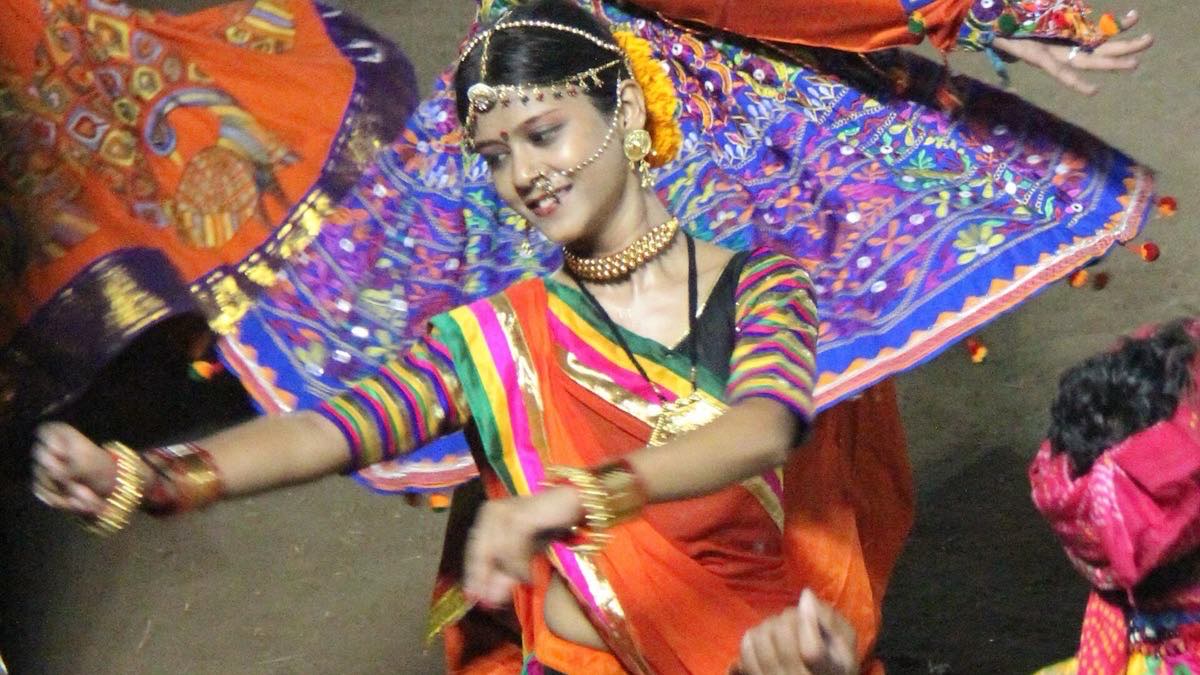
What Is Garba? A Beginner's Guide
Garba is Gujarat's circle dance of Navratri, now danced worldwide. What it is, where it comes from, and how a total beginner can join a circle.
If you have ever watched a garba night from the edge of the floor and wondered what exactly is happening out there, this guide is for you. No background needed, Gujarati or otherwise.
Where does garba come from?
Garba comes from Gujarat, in western India. The name traces back to the Sanskrit word garbha, meaning womb, and the dance’s original centerpiece makes that connection literal: a clay pot called a garbo, pierced with holes and lit from within by a lamp. Many traditions describe the garbo as carrying 27 holes, though the count varies by region and family; whatever the number, the light glowing through them represents divine life inside the vessel.
Dancers move around that lamp, or around an image of the goddess (Amba, Durga, Shakti in her many forms), during Navratri, the festival of nine nights held in her honor. The circle is not decoration. It is the meaning of the dance: the goddess at the center, the community revolving around her, everyone facing in, no one dancing alone.
That is also why garba’s recognition by UNESCO in December 2023, when “Garba of Gujarat” joined the Representative List of the Intangible Cultural Heritage of Humanity, cited the dance’s power to bring communities together across caste, class, and background.
How is garba danced today?
Everywhere Gujaratis have gone, garba has gone with them, and it has long since outgrown any single community. In India, cities like Vadodara famously host garba grounds with tens of thousands of dancers each Navratri. Across the diaspora, from New Jersey to London to the Bay Area, Navratri means packed halls, live singers, and circles inside circles spinning late into the night. The crowd at these nights is far broader than Gujarat: garba today is pan-Indian, and increasingly not just Indian.
The dance itself still works the way it always has. Everyone performs the same repeating step, traveling counterclockwise around the center. The music starts slow and builds, and as the tempo rises the circle rises with it. You do not need a partner, an audition, or a costume. You need the step, and the step repeats.
What is the difference between garba and dandiya?
Short version: garba is danced empty-handed, with claps and spins, traditionally before the evening aarti (the prayer ritual). Dandiya raas is danced with a pair of decorated sticks, struck in rhythm with a partner, usually after the aarti. Both are Gujarati, both belong to Navratri, and most events feature both in a single night. We break down the differences fully in Garba vs Dandiya: What’s the Difference?
Is garba a good workout?
Honestly, yes. Thirty to sixty minutes of continuous stepping, clapping, and spinning is real aerobic exercise, the kind health guidelines actually count. That said, nobody in a garba circle is watching a calorie counter, and the workout is not why people come back. We dig into the fitness side (and what matters more) in a dedicated post on whether garba is a good workout.
How do I start dancing garba in the Bay Area?
You have two on-ramps, and they work best together.
The events. Navratri 2026 runs October 11 through 20, and Bay Area garba nights typically begin filling the calendar from late August. The region hosts 50+ garba and dandiya nights a season, from touring artists like Falguni Pathak and Atul Purohit filling convention centers to community nights run by the Gujarati Cultural Association in Fremont. And the circles are broader than you might guess: American Community Survey data shows Gujarati speakers are only about 6.6% of the Bay Area’s roughly 347,000 Indic-language speakers, yet the floors keep filling. A big night is unforgettable, but it is a hard place to learn: thousands of people, fast music, and no one teaching.
The classes. A weekly class is where the steps actually become yours. At Garba Groove, beginner-friendly garba classes teach the foundational steps in a welcoming circle, with no experience needed and every background explicitly welcome. Garba Groove was started by Fenil, a Gujarati who has danced garba for over a decade, and the whole point is that the Bay Area deserves a circle to learn in, not just a night to attend once a year.
Start with the basics (these foundational steps are learnable in words before you ever step on a floor), join a class, and by the time the Navratri 2026 season arrives, you will be the one pulling friends into the circle instead of watching from the edge.
Come dance your first class. The circle has room.
Frequently asked questions
What is garba?
Garba is a Gujarati folk dance performed in a circle during Navratri. Dancers move around a central lamp or image of the goddess with rhythmic claps, steps, and spins. Today it is danced worldwide, by people of every background, as a celebration of community and joy.
Is garba Gujarati or Rajasthani?
Garba comes from the state of Gujarat in western India. It is sometimes confused with Rajasthani folk dances like ghoomar, but garba and dandiya raas are Gujarati traditions tied to Navratri.
Do you have to be Gujarati or Hindu to dance garba?
No. Garba began as devotional worship and that history deserves respect, but modern garba nights and classes welcome everyone. In the Bay Area the circle regularly includes Gujaratis, Indians from every region, and plenty of non-Indian dancers too.
Is garba hard to learn?
No. The basic steps repeat in a loop, and because everyone dances the same step at the same time, you learn by joining the circle and following along. Most beginners are moving with the circle within one class.
Keep reading
Garba vs Dandiya: What's the Difference?
Garba is danced empty-handed in a circle; dandiya raas uses sticks and a partner. How the two Navratri dances differ, and why most nights include both.
Read →Basic Garba Steps for Beginners
Learn the foundational garba steps from zero: the two-clap (be taali), the three-clap (teen taali), and simple spins, plus how to practice at home.
Read →Navratri 2026 in the Bay Area: Dates & Where to Play Garba
Navratri 2026 runs Oct 11–20. How the Bay Area garba season works, when the lineup drops, and how to get dance-floor ready before the first night.
Read →